


© Osengwa LLC. 2021 All Rights Reserved.
Ayobami Ogungbe’s story is one that evokes a profound sense of historical continuity, bridging the gap between his roots in Badagry and his creative awakening at the University of Benin. Although he studied Mass Communication, the sculptural landscape of Benin and a pivotal photojournalism course transformed photography into his primary medium for documenting culture. His practice reached a breakthrough during the pandemic, when he began weaving photographs together: a technique that merges the photojournalistic skills he honed in Benin with the indigenous weaving traditions of his hometown, Badagry. Today, his work serves as a vehicle for community agency, using public installations and “By Way of Water” narratives to reclaim historical sites and celebrate the shared heritage of Nigeria’s coastal communities.
Ayobami Ogungbe
We conclude our series with Ayobami Ogungbe, whose work provides a tangible anchor to Chidinma Nnoli’s call for community and space. While Chidinma focused on the sanctuary of the studio, Ayobami steps out into the landscape. Influenced by the same sculpture-rich campus that shaped his peers, he uses the camera and the loom to transform history into something you can touch, ensuring that the stories of our coastal communities are woven into the very fabric of the present.
I had a conversation with Ayobami Ogungbe about his journey and practice.
Background and Connection to Benin
1. Question: Can you tell me about how your experience at the University of Benin connected, or maybe didn’t even connect to your creative path today. Also, how did your choice of course influence where you are today in the creative space?
Answer: I got admitted into the University of Benin in 2011/2012, and graduated in 2015. One of the biggest things Benin gave me was photography. I studied Mass Communication, not Fine Art or anything directly related. The Mass Communication Department was on the same campus as Fine Arts, and the campus itself wasn’t large. It housed just three departments: Fine Art, Mass Communication, and Theatre Arts (all under one faculty), plus the Department of Education, which was mostly part-time students. So, the campus felt like two active departments: Mass Communication and Theatre Arts, the Fine Arts.
If you’ve ever been to that campus, the moment you walk in, you’re greeted by sculptures scattered everywhere. You immediately know you’re in the Fine Arts campus. That alone contributed to my artistic leaning. I already had a Fine Art background from Badagry, where I worked as an apprentice in a Fine Art studio before gaining admission. I also studied Fine Art in secondary school, and my Father had always supported my drawings and paintings as a child. So I was already coming from that world.
Being on the Fine Art campus in Benin simply continued that trajectory. The Fine Art students were always outside working on assignments: drawing, painting, creating, always visible. And because I already had that background, it felt natural to stay close to that ecosystem.
But what really solidified everything for me was a photojournalism course I took in my second year of Mass Communication. We had to learn how a camera works, and I remember holding one for the first time and instantly knowing that it was a medium I wanted to create with.
Eventually, I got a small camera and began documenting my friends on campus: events, shows, portraits. Before long, I became known as the campus photographer.
In my third year, when it was time for my internship, I went to the Nigerian Observer Newspaper in Benin City. I worked there for six months, documenting events and taking photographs for the newsroom. So photography gradually became a part of my identity.
It’s easy to see how Benin laid the foundation for where I am today, especially through the relationships I built on campus. I was close to students in the Fine Arts department like Jonathan Chambalin, Josh Egesi, and Jordan Belonwu. Chibuike Uzoma, now a painter, also played a big role. Even though he studied painting, his medium back then was photography. He introduced me to fine-art photography: the idea that a photograph could be created and presented as fine art. He exposed me to other photographers, to books, and to the understanding that to be a good photographer, you have to read and study. All of this shaped the kind of work I make today.
After graduating from the University of Benin, I went to serve in Cross River State. I ended up documenting my Place of Primary Assignment: my students, the classroom, the community, the market, the New Yam Festival and the landscape. I compiled the photographs into a photo essay, and that project was selected for the World Press Photo Satellite Masterclass. From there, my career really took off. Since then, I’ve chosen photography as my primary medium for telling the stories I care about.
So yes, Benin has been incredibly instrumental to my practice.
2. Question: Were there any specific experiences or people (professors or classmates) or, you know, just colleagues in the University of Benin, that have influenced your work just briefly.
Answer: Yeah, I mean, there was one person who was really influential to me, his name is Chibuike Uzoma. He’s an artist, primarily a painter, and he studied Fine Art. Jonathan Chambalin is another close friend; we’ve known each other for a long time.
Then there’s Dr. Oyegun, who introduced me to Victor Ehikhamenor, one of Nigeria’s leading contemporary artists today.
Those three were really the pillars of knowledge and inspiration that guided my orientation at the time.
3. Question: Do you know if the culture and art scene in Benin affected or influenced your creative process and your creative flow?
Answer: Yeah, absolutely. Eventually, Victor Ehikhamenor became my mentor, and he still is to this day. His work is deeply rooted in his upbringing in the Uwessan and its cultural ties to the Kingdom of Benin. I interned with him for a while before deciding to pursue my own path. During that time, I accompanied him on assignments documenting important cultural events like documenting the Oba of Benin, the Holy Arousa Church and the Igue festivals.
So, I spent my early years as a photographer in Benin, capturing culture and telling stories as Victor Ehikhamenor’s intern. I also spent a lot of time photographing his artworks and documenting his creative process in the studio. Being so close to both the art and the culture gave me a unique insight into Benin’s heritage, and that experience has definitely influenced much of the work I do today.
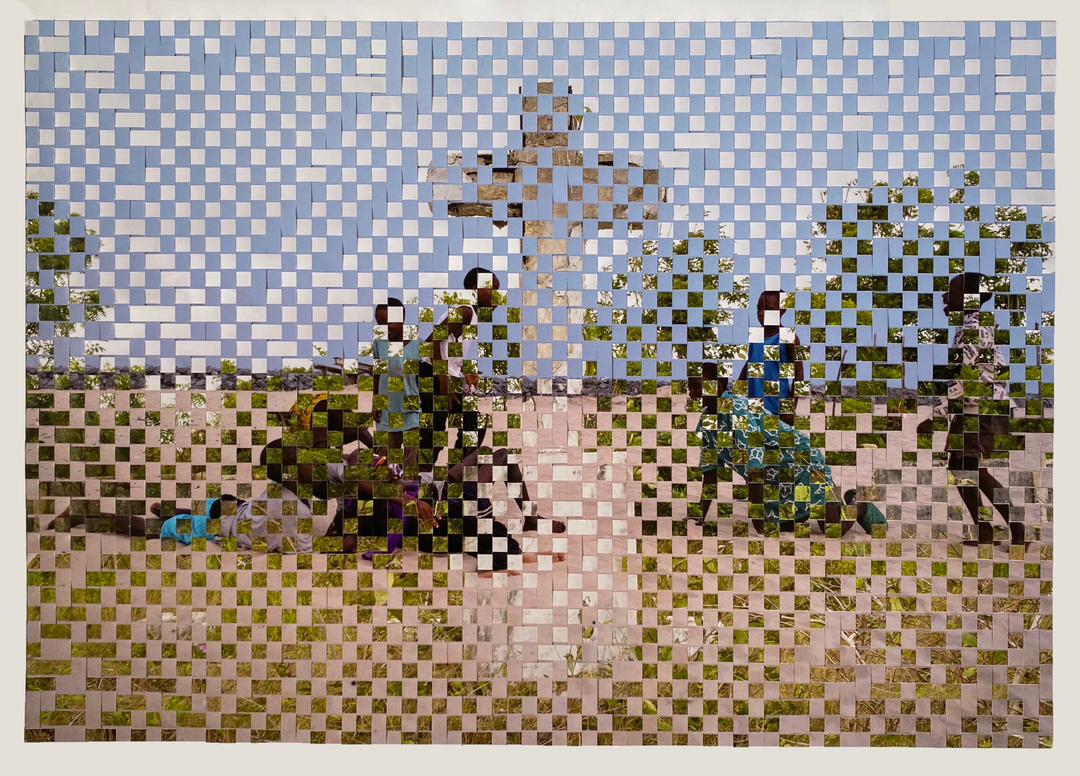
Ayobami Ogungbe’s Artwork (Image Courtesy of Ayobami Ogungbe)
Career Turning Points and Challenges
4. Question: What were the turning points? I helped you move from interest to cash to profession in your creative field.
Answer: For me, it really happened during the pandemic. At the time, I was mainly doing documentary photography, but once everything shut down, we were all stuck inside. Like many creatives, I struggled, there was no way to go out and make new work. But I had all these photographs I’d taken over the years, just sitting with me, and I needed a new way to bring them to life. So I turned inward.
I went back to Badagry, spent time with my parents, and reconnected with where I grew up. That was when I started noticing how much weaving showed up everywhere: as a craft, a cultural language and a rhythm in the community. It was something deeply rooted in Badagry. Since it was part of my own roots, I decided to give myself a voice through it by weaving my photographs into one another.
That’s really how my current practice was born. The piece behind me, for example, is made of images woven together. It became this merging of the photography I began in Benin with the weaving traditions from Badagry: two parts of my life coming together to form something new.
In many ways, the pandemic forced me to rethink my work and create from a more personal place, and that’s what led me to where I am today.
5. Question: Are there any specific challenges you have faced in your creative process, and how do you overcome it?
Answer: Well, I don’t think my challenges are unique to me. They’re the kinds of things every creative person faces. You want to grow your practice, but that comes with a lot of sacrifice. Sometimes you have to wait until you make a sale just so you can reinvest in your studio. Other times, you take on commercial work or different jobs to earn enough to pour back into your art and keep pushing your boundaries. So honestly, I don’t see my challenges as anything unusual, they’re pretty much what everyone in this field is dealing with.
6. Question: You mentioned that you transitioned from being Victor Ehikhamenor’s intern, being his intern, to doing your own thing. What was that process like?
Answer: Victor Ehikhamenor had always encouraged me to start my own thing, to step into being a full-time fine artist. He would say I could still shoot commercially to support my studio, but with art, you really can’t force it or rush it. You have to let it take root, let it marinate, and wait for the moment when it starts speaking to you.
I just didn’t feel ready at the time he pushed for me to forge my own path. It actually took the pandemic for that shift to happen.
But yes, Victor Ehikhamenor consistently pushed me to step out, to stop being an intern forever, and to build something of my own. The pandemic ended up being the tipping point that made it all click.
Current Practice and Projects
7. Question: Can you tell me about your current practice and any ongoing projects you’re excited about?
Answer: My practice right now mainly focuses on stories from my hometown, Badagry, and on its endurance. Badagry carries a deep, layered history, with so many narratives that I don’t feel have been adequately represented in Nigerian, West African, or even global art spaces. And while there are artists from Badagry who have been engaging in these conversations for years, it felt important for me to join in: there’s strength in numbers.
It was also personal. I was trying to understand my own identity, what I wanted my work to stand for, and the kind of impact and voice I wanted it to have. So it made sense to trace Badagry’s contributions to trade along the transatlantic coast, the transatlantic slave trade, its colonial and missionary presence, and how all these shaped Nigeria’s social and political landscape. Badagry was central to the advent of Christianity in Nigeria and functioned as a British outpost, so the history runs deep.
Because I work with photography, this all became a full-circle moment. I found myself documenting old colonial spaces, administrative buildings, and the lingering effects of missionary and colonial systems in the community, and using my work to amplify Badagry’s significance in Nigeria and West Africa. Incorporating the indigenous weaving culture into my practice made the process even more meaningful. It just fit; it felt like everything aligned.
Right now, I’m collaborating with communities in Badagry to install public sculptures and large-scale art installations. One of the pieces, the one I posted on Instagram, went viral and people really connected with it. We created it with a Waterside community, using local materials like the reed used traditionally to weave mats and baskets.
The whole idea is to re-engage with indigenous knowledge systems, to create new contemporary visual languages from them, and at the same time give the community a real sense of agency and ownership in the creation process. Most of these installations will go up in old colonial sites across Badagry, as a way of reclaiming those spaces.
This project is something I’m genuinely excited about. We’re planning to go fully into it starting in 2026. Right now, we’re gathering human and financial resources, but we’ve already completed two public installations. And when the larger works are finally installed, the community will come together to celebrate with dance, performance art, indigenous music, poetry.
It’s really a way to bring community theatre into public art, and we’re incredibly excited for what’s coming next.
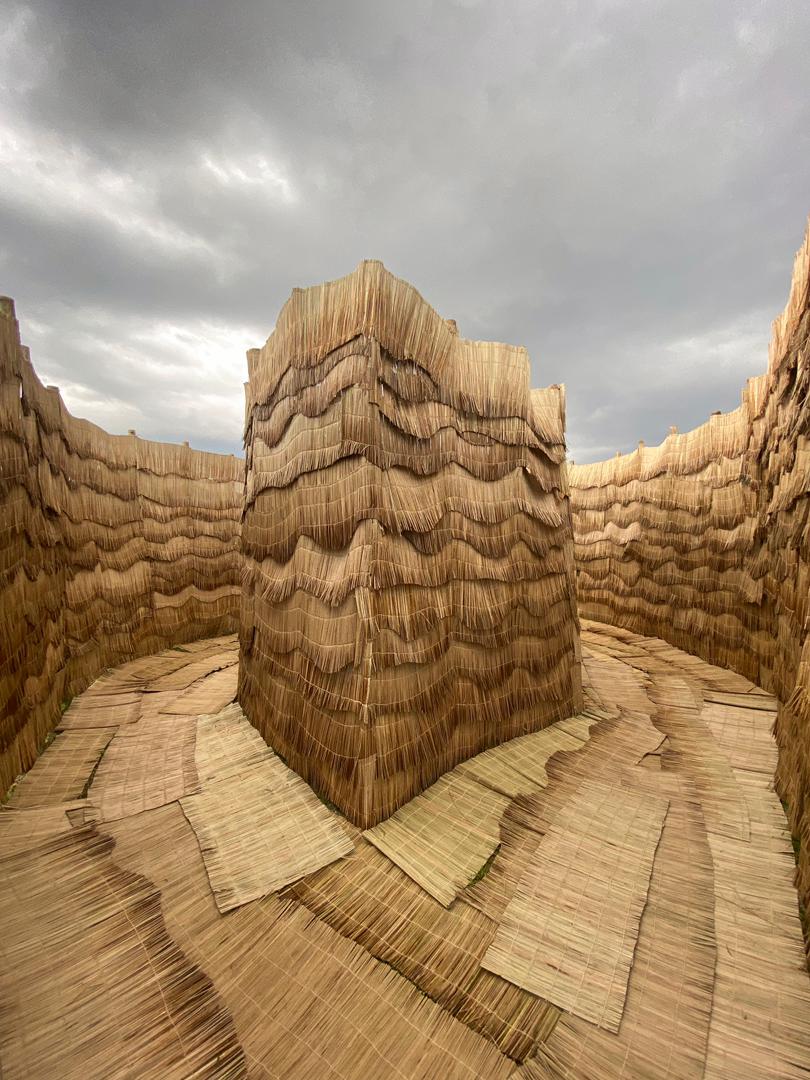
Ayobami Ogungbe’s Artwork, By Way of Water (Image Courtesy of Ayobami Ogungbe)
8. Question: Will this project be documented?
Answer: Oh yes, absolutely! Everything is being documented, we’re filming and creating documentaries. We’re conducting interviews with the locals, the weavers, and everyone involved. It’s truly a whole community project.
We’re also holding workshops, bringing fine artists from Lagos to engage with young people in the community and show them the possibilities of working with the materials found right in their own environment.
9. Question: I can see a connection between where you grew up and where you studied. How did that impact your work?
Answer: So, the last public installation we completed was installed in Benin City, but it was woven and built entirely from scratch in Badagry. When you look at history, Badagry and Benin City share very similar trajectories; both shaped by colonial presence, the transatlantic slave trade, and long histories of resistance against colonial systems. They also both sit along the Bight of Benin, which stretches from the Niger Delta down toward Togo and Ghana. That stretch of water was a major transatlantic route, carrying countless people away to the West, to Brazil, and to Europe.
A key idea that stood out to me while working on this project was the concept of return, and how powerfully it resonates with both places. In Benin City, there is an active movement demanding the return of artifacts taken centuries ago. And in a different but deeply connected way, Badagry is also experiencing its own form of return, people of African descent coming back to trace their ancestry and see the exact points where their forebears departed the continent.
The installation, titled By Way of Water, was made in Badagry and then presented as a gift to the people of Benin. We transported it all the way from Badagry and installed it at the Black Muse Sculpture Park in Benin City. The reception was far beyond anything I imagined; it went viral, was widely embraced, and even won a sculpture prize, which I’m incredibly grateful for.
These are the kinds of stories we want to keep telling: community-rooted narratives that connect history, movement, memory, and identity. The sculptures, performances, music, and all the work moving forward will be created in collaboration with the indigenous communities in Badagry. It’s important that they have a sense of agency, that they are part of the entire process, because ultimately, these stories and these works belong to them.
10. Question: How do you define success or fulfillment in your work?
Answer: Right now, my practice is still evolving, but at this stage, what matters most to me is the impact it will have on my people: the community in Badagry. That’s really the heart of these public installations we’re creating. The goal is to involve the community directly in making fine art that will be permanently situated in their own environment, so that children, visitors, and local artisans can engage with it, contribute to it, and feel a genuine sense of ownership.
Beyond the cultural and symbolic value, these projects also create economic opportunities. They become something that gives back to the community and supports local development. So for me, impact, especially impact within my hometown, is how I measure success now.
And even with just two installations completed so far, we’re already seeing growing attention and interest in what we’re building in Badagry. For me, that feels like the beginning of something truly meaningful and transformative.
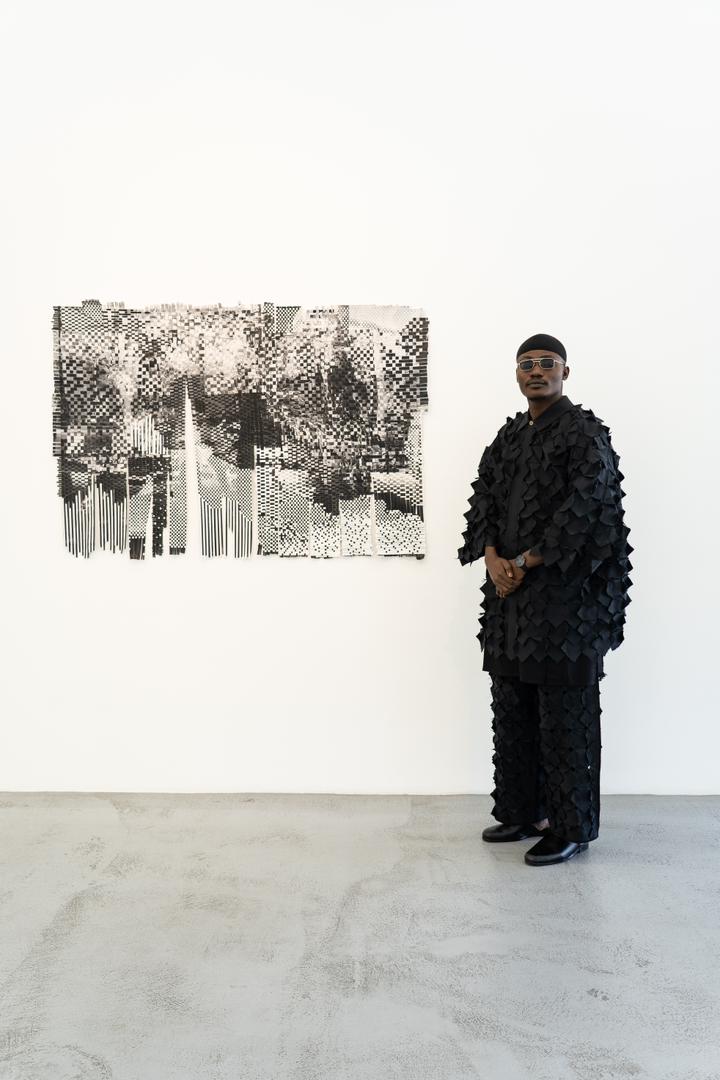
A Photo of Ayobami Ogungbe (Image Courtesy of Ayobami Ogungbe)
Reflection & Advice
11. Question: What advice would you give to current students who want to follow a similar creative path?
Answer: You really have to be honest with yourself. There’s this misconception that you’re just going to blow up overnight. Maybe you will, but what if you don’t? You have to ask yourself whether this is truly what you want to do. There needs to be a genuine sense of gratification you get from making the work itself, not just the hope of being big or making money.
You need to decide if this is the life you want, and trust that things will fall into place in their own time.
It might not happen quickly, the art world is unpredictable like that. Some artists practice for 30 or 40 years before getting their big break.
So no matter what, you have to keep doing the work. Just make up your mind that this is really the path you want.
12. Question: How can you stay inspired and grounded as a creative professional?
Answer: I look at the work of other artists I admire, and I’m constantly researching. I’ve always seen myself as a student of history because history is what anchors my practice. I read widely, pay attention to the social landscape in my hometown, visit and document important sites, and immerse myself in continuous research. It’s really a mix of all these inputs that I intentionally expose myself to when I’m creating new work.
I stay very open-minded: anything and everything can matter. You have to take in a lot of information, then digest and interpret it carefully so you don’t unintentionally misrepresent what you’re trying to communicate through your practice.
I don’t follow a strict, step-by-step process. I usually have a central theme I’m exploring, and from there I move between different methods and influences as they come. I also let the work guide me. Eventually things start to align and make sense.
And of course, not every piece makes it out; many don’t, simply because they don’t communicate the original intention clearly.
MOWAA Situation
13. Question: How did the recent events at MOWAA in Benin strike you as an artist and as someone rooted in the cultural landscape of Benin?
Answer: I don’t really know exactly what happened. I heard about it maybe the second day after the situation. But I truly believe it could have been handled better. For something like that to happen on that day doesn’t reflect well on the art world. What we want is more people to visit and to listen when we share our stories, and for the space to be welcoming and accommodating.
I’m speaking purely as an artist, I don’t know all the details behind what led to that moment, but it definitely could have been managed more sensitively. That situation didn’t need to happen. But we don’t stop. We keep going, forming strong alliances, telling our stories, and pushing forward.
The Nigerian art scene as a whole has done incredibly well, and this one incident shouldn’t be amplified so much that it dents the whole ecosystem. This art system was built by many people, even before I was born.
So yeah, we just keep moving forward.
As this four-part series closes, Nnoli’s voice becomes a call to action. Her reflections on the MOWAA situation and the limited institutional access available to local students reveal a critical truth: for the Nigerian art scene to truly flourish, the talent cultivated in places like UNIBEN must be met with infrastructure that is not only world-class, but genuinely accessible.
In the stories of Jonathan, Prince Charles, Chidinma and Ayobami, we see a shared thread, a “guild” of creators who found their voices in the same hallways and now stand as pillars of a new contemporary canon. They remind us that while the path of an artist is often one of individual bravery, its foundation is almost always built on the strength of the collective.